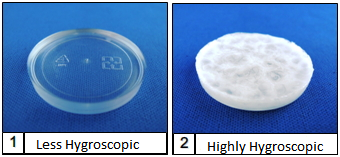
Room temperature curing epoxy resin commonly cure using an amine hardener system. Amine has high alkalinity and hydrophilicity. During the curing process, it will rapidly absorb moisture from the atmosphere. The resultant high moisture content will cause surface finish defects. The cured surface may have a textured finish and in severe cases, the entire surface will have a chalky appearance.
Fig.1 Shows a cured epoxy resin surface that is less hygroscopic. Fig.2 Shows a cured epoxy resin surface that is highly hygroscopic.
Since such surface finish defect is caused by moisture absorption, it is also related to the weather condition. Sunny weather conditions will produce good surface finish and conversely, bleak weather conditions will result in poor surface finish. Temperature is the other factor that will affect the surface finish. High temperature speed up reaction time which will reduce the moisture absorption time producing a better surface finish. The converse will be true if the temperature is low. Curing the resin in an oven at elevated temperature will not cause any surface defect due to the fast reaction time and low humidity.
However, the effect of moisture on hygroscopic formulations of adhesives is negligible since the resin hardening process is enclosed by the bonding surfaces. This surface defect will be more evident in potting application. This can be overcome by taking the ambient temperature and weather conditions into consideration during processing.
PTV200 Pinch Tube Valve Brochure Download
JV200 Jetting Valve and Controller
Brochure Download
UVLSPOT LED UV Spot Curing System
Brochure Download
MM3000GP Series Gear Pump Meter-Mix Dispensing System Brochure Download